Brightly colored, upcycled birdhouses are among the most charming forms of garden art. But if you want a birdhouse that’s actually for the birds, you need to consider a lot more than human aesthetics in your design. Birds will only use nesting boxes that mimic the ones they build or find in nature. They usually have specific requirements about size, shape, and placement of entry. No matter how cute they are, most of the birdhouses sold at the craft fair don’t even look like houses to the birds.
This article contains affiliate links, which help fund our Recycling Directory, the most comprehensive in North America.
Specificity
It’s obvious once you think about it, but different kinds of birds have different nesting needs, so it helps to know which bird you are building a house for. Many Audubon Society chapters provide building designs for bird species that are local to their area and likely to appreciate a well-designed birdhouse. (Not all birds can be convinced to take up residence in an artificial nest.) The U.S. Fish and Wildlife Service maintains a partial list of bird species that can be attracted to nest boxes and explains their housing requirements.
The Audubon Birdhouse Book presents detailed, biologically appropriate designs for more than 20 North American bird species.
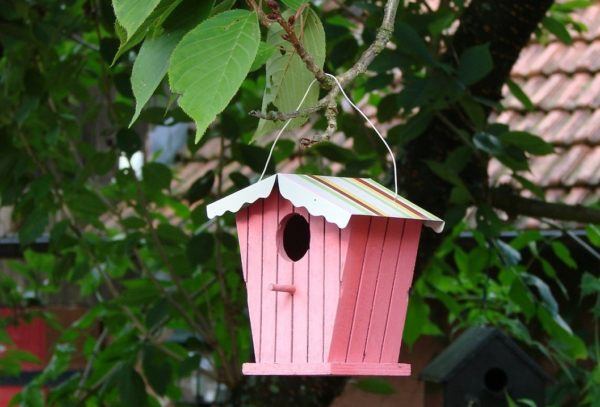
This birdhouse may be cute, but the perch is more helpful to predators than the to birds. Photo: rlehmler, Pixabay
Location, Location, Location
It’s the most important element of human real estate, and it matters to birds, too. No matter how perfectly built your birdhouse is, if your yard doesn’t provide species-appropriate habitat, the birdhouse will remain empty.
For most birds, a good neighborhood means having a source of water and food — but not too close to bird feeders, which could result in crowding and competition. A house mounted on a metal pole with metal cone guards might not be as attractive as one nailed to a tree, but the chicks inside it are much safer from predators. Even the orientation of the house can make a difference — bluebirds always prefer east-facing houses, but if you live in a hot climate, orienting a birdhouse to the south could make it unlivable for any species.
Amenities
Like people, different birds look for different things in a home. Cavity-nesting birds seek out nests with ideal dimensions, which are specific to each species. Porches and doors make a big difference in a home’s curb appeal. The proper size and placement for the opening hole in a birdhouse is critical to birds. But those cute little perches by the door of traditional bird houses are more helpful to predators than to the birds, so leave them off of any birdhouse.
Another universal? No matter how protective the roof, some rainwater is bound to get into any birdhouse; include drainage holes to keep chicks dry. If you include a removable roof or back panel, you can clean out the bird house in-between tenants. Most birds won’t set up house in a dirty box.
With a little bit of research, it’s easy to buy or build a birdhouse that is really for the birds.
Feature image courtesy of Peter Heeling, Skitterphotos. This article was originally published on October 4, 2018.
You Might Also Like…
Livable Housing — for the Birds
May 19, 2020Crafts Made From Upcycled Food Packaging
May 19, 2020The Consequences of Climate Change
May 18, 2020The post Livable Housing — for the Birds appeared first on Earth911.com.
from Earth911.com https://ift.tt/2Cty3wr https://ift.tt/2Tf5aKY
Comments
Post a Comment