Lately, it seems like every year is a bad year for wildfires. If you live in an area prone to wildfires — most of the American West — you naturally want to minimize that risk. And there are natural ways to do so.
A wildfire-resistant landscape won’t necessarily protect your home from the flames, but it improves the odds of your home’s survival compared to a traditional garden. While it is possible to design a fire-resistant landscape to fit almost any aesthetic, fire-resistant landscaping guidelines will usually result in a natural landscape that blends in with the surrounding environment.
Defensible Space
Defensible space is the central concept behind wildfire-resistant landscaping. For most homeowners, defensible space refers to two zones surrounding the house. Yet, the term is often misunderstood as a 100-foot vegetation-free area around the house.
But keeping all vegetation 100 feet away from built structures is not only ugly, it increases other environmental problems like flooding and erosion. Defensible space is actually a set of environmental design principles that slightly increases the likelihood of a fire passing by a house and it greatly increases firefighters’ ability to defend the building. And if you live in California, it’s required by law.
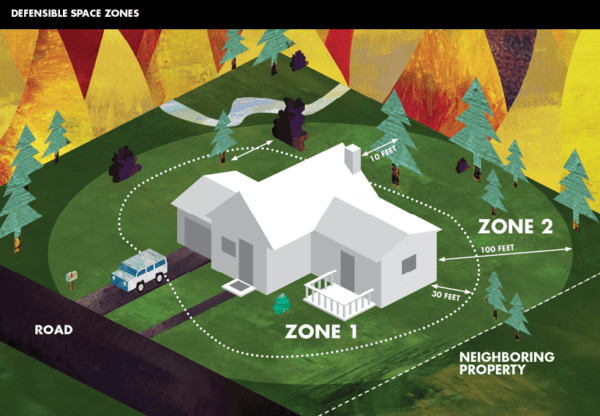
Most homes require 100 feet of surrounding defensible space. Image: Cal Fire
Very large properties may be broken into four zones. Zone 1 extends 30 feet out from the building. This zone can include vegetation and even trees, but plants should not touch or overhang the house, especially near chimneys and windows. Space woody plants or “islands” of vegetation at least 10 feet apart to prevent fire from finding a path to the house. In Zone 2, which extends for the next 70 feet, keep ground covers low, and space woody plants vertically and horizontally to minimize the ability of fire to spread. Spacing guidelines vary depending on the slope of the property. You can find detailed spacing guidelines for defensible space on the Cal Fire website.
Reduce Fuel
Much of fire-resistant landscaping relates to minimizing fuel for the fire. This includes removing dead branches from woody plants and, during the dry season, clearing plant litter from the ground. It also means keeping grasses mowed. Grasscycling should not be a problem, as long as the lawn remains green. Although organic mulches offer many benefits for plant health, in areas with high fire risk, it’s better to keep the ground clear of organic matter and use inorganic materials like gravel as mulch instead. Wide, paved pathways and inorganic mulches serve as fuel breaks, that is, they not only reduce the overall area covered by organic matter, but they also increase the distance between individual plants. This increases the distances flames must jump to continue spreading.
Water conservation is usually a concern in dry, fire-prone regions. But drought-stressed plants catch fire more easily and burn faster, so it’s important to keep plants healthy and well-irrigated. The competing concerns of water conservation and fire prevention are somewhat mitigated by the fact that wildfire-resistant landscapes are not as densely planted as traditional garden landscapes and therefore do not require as much water.
Plants and Materials
Plant selection further mitigates the need for irrigation water. Native plants and nativars will thrive with less supplemental watering than imported species. Because wildfires are a natural part of environmental cycles in the western U.S., there are many fire-resistant native species. Many horticultural varieties of shrubs, perennials, and ground covers are fire resistant, as well. Look for high-moisture species with a compact shape and low sap or resin content. Check your local nursery or local cooperative extension office for advice on fire-resistant plants suitable for your area.
Don’t forget garden furniture and ornaments, either. Wooden fences and upholstered chairs fuel a fire as easily as woody plants.
Planning
A fire-resistant landscape will bounce back quickly after a fire and can help prevent your home from burning. But there is no such thing as a fire-proof landscape. Learn what you can do to prevent fires and prepare your family with a wildfire action plan. CalFire maintains an excellent preparation website and wildfire planning app for both Android and iOS.
This article was first published on September 17, 2018
You Might Also Like…
Landscaping for Fire Resistance
August 31, 20207 Ingenious Upcycling Ideas You’ll Fall in Love With!
August 31, 2020Earth911 Podcast: Sustainability at Home — Food, Detergents, and Reuse Projects
August 31, 2020
The post Landscaping for Fire Resistance appeared first on Earth 911.
from Earth 911 https://ift.tt/31FsMwS https://ift.tt/31FsMNo
Comments
Post a Comment